AI Platform & ERP Integration Case 01

Green Tech

We designed and built Green Tech a custom Astro and Payload CMS platform that runs 1,200 LED and HVAC products in two languages, with an AI Studio that improves, translates and checks product data, daily stock and partner sync from the Pantheon ERP, and AI tools that help buyers size a lighting project.

ClientGreen Tech / Gama Electronic
IndustryLED Lighting · Heating & Cooling
Timeline6 months
Last updated2026-10-28
AuthorKonzept team
TeamAdnanAlenVahaMirzaAdisAzraSaraFedja

We gave Green Tech one platform for its catalogue, its data and its partner network. The public site runs on Astro, and the content runs on Payload CMS. Inside Payload we built AI Studio, a custom plugin that reads every product, finds missing or weak data, writes better copy, translates it between HR/BS and English and checks the result before an editor publishes it. The Pantheon ERP feeds partners and stock into the site every day, products stay in step with the Green Tech B2B website, and a Firecrawl pipeline crawls partner sites to collect product links. On the front end, generative UI and an AI advisor turn a buyer's project into a lighting proposal from the catalogue.

Live site · viewport
greentech-solution.eu
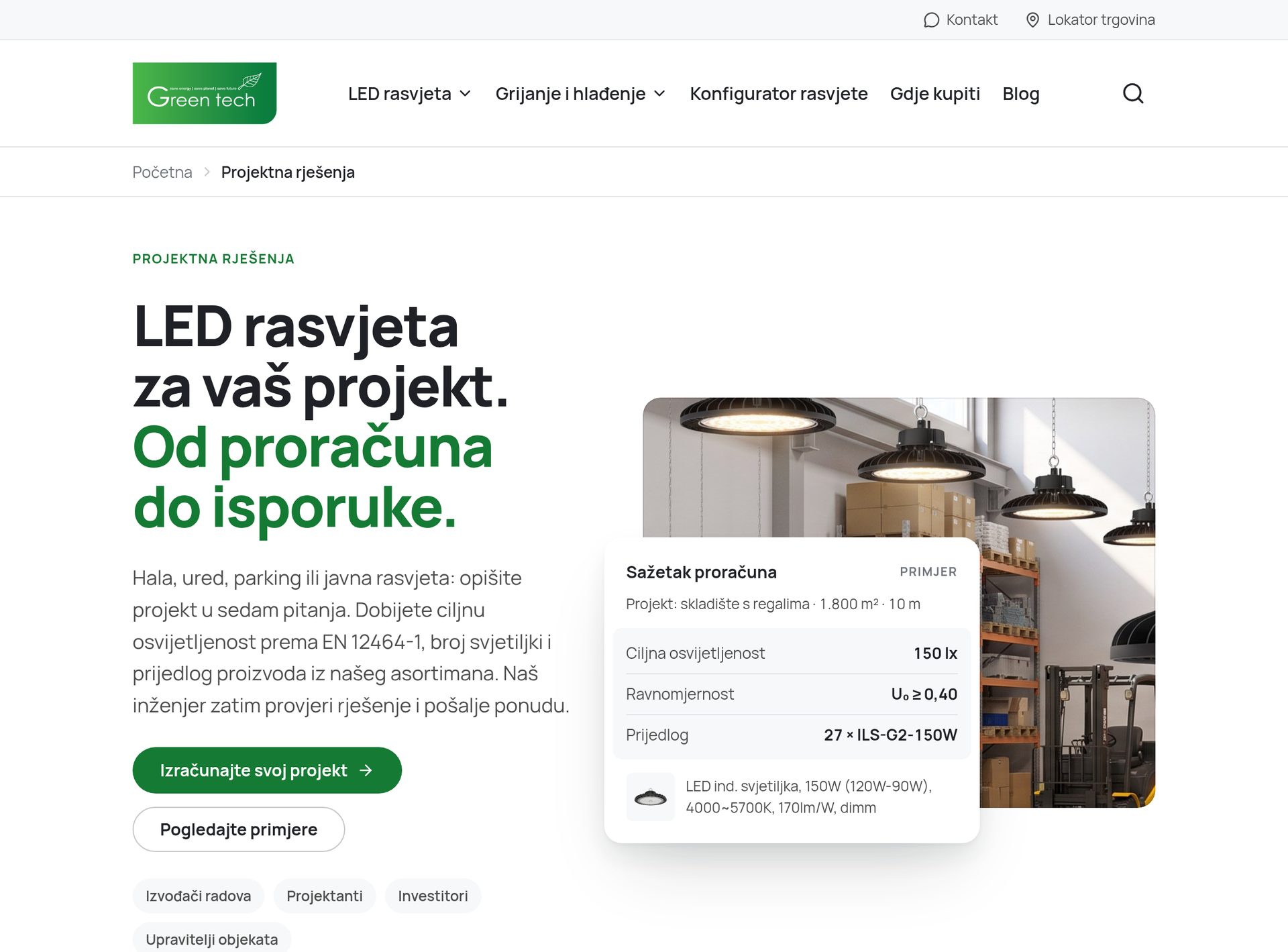
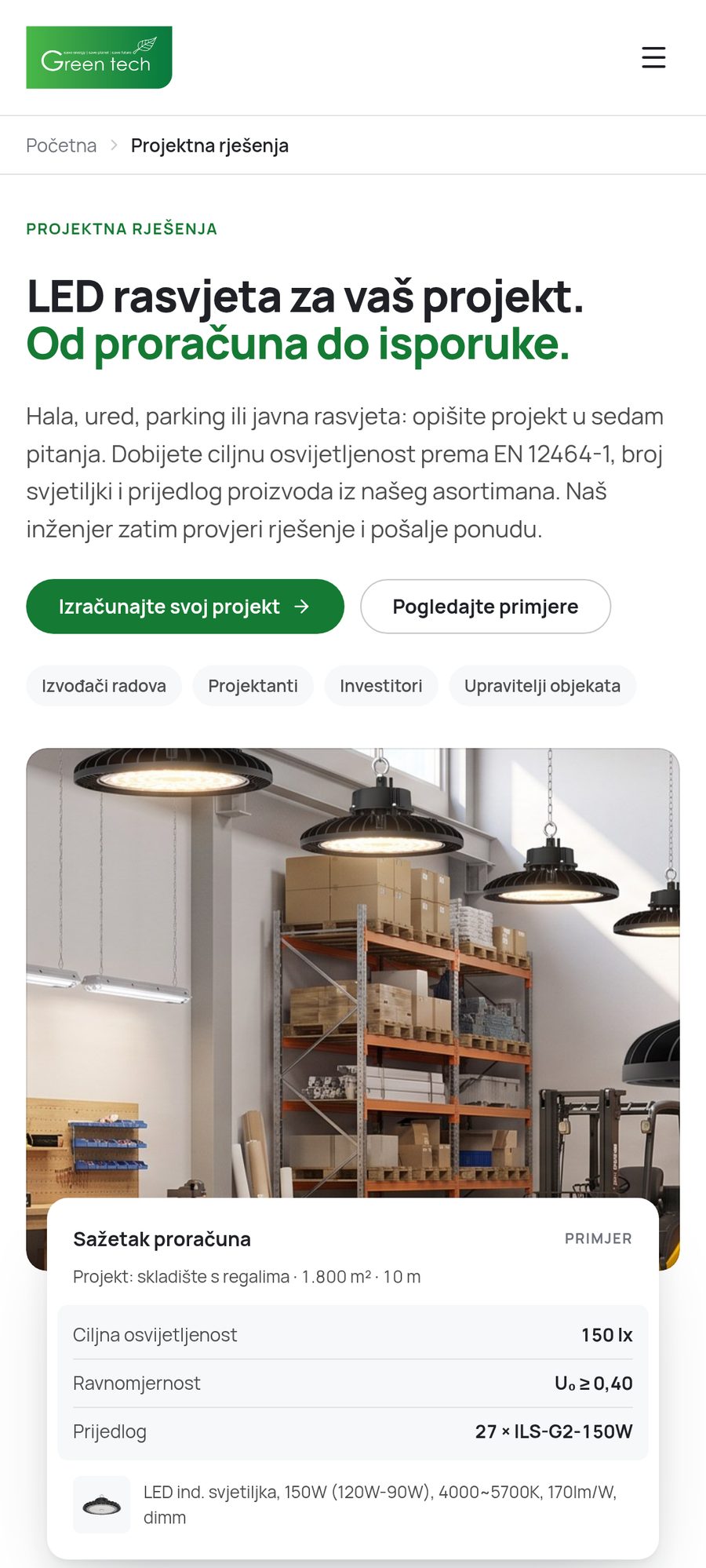
Green Tech project solutions page with a sample lighting budget
01 / 03

The Challenge

Green Tech / Gama Electronic supplies energy-efficient LED lighting, heating and cooling through a network of distributors, retailers and installers across Bosnia and Herzegovina, Croatia and the wider region. It is a catalogue and a support desk, not an online shop: buyers find the right product on the site, and a partner near them sells, installs and services it.

That model lives or dies on data. An LED fixture is a list of numbers: watts, lumens per watt, Kelvin, IP and IK ratings, driver, certificates. A buyer who sees a wrong number orders the wrong fixture, and a partner who sees an empty spec table calls Green Tech instead. The catalogue held more than a thousand products, with data spread over the Pantheon ERP, supplier datasheets, the B2B website and spreadsheets. Every description had to exist in HR/BS and in English. Partners and stock lived in Pantheon, so the site could not say who sold a product or whether it was in stock. Editors filled the gaps by hand, one product at a time.

The brief: one platform that keeps products, partners and stock true without manual work. Give the content team AI tools that do the heavy work and keep a human in control. Connect the site to Pantheon and the B2B website. And give professional buyers a faster way from a project to the right products.

02 / 03

The Approach

We started from the data, not the design. Green Tech's value is correct product information and a partner near the buyer, so we built the systems that keep both true first: the Pantheon and B2B syncs, the crawler and AI Studio in Payload. Then we designed a fast Astro front end that shows that data clearly, in two languages, and uses AI where it saves the buyer time.

01

AI Studio in Payload

We built AI Studio as a custom Payload CMS plugin. An editor opens a product or a page, and AI Studio analyses it: missing specs, weak descriptions, values that do not match the datasheet, untranslated fields. It proposes improvements, writes the copy, translates it between HR/BS and English and runs its checks again. The editor talks to it, accepts or edits each change and publishes. Nothing goes live without a person.

02

Verified Product Data

Every product carries a structured spec sheet: electrical, light and mechanical data, certificates, EAN and documents. AI Studio checks those fields for gaps and conflicts, and each product page shows the date its data was last verified. Buyers and partners read one set of numbers, and the team knows which products still need work.

03

Pantheon ERP Sync

A custom integration reads partners and stock from Green Tech's Pantheon ERP every day. Distributors, retailers, installers and service partners appear on the store locator with their address, type and contact, and every product shows its stock state. When Green Tech signs a partner in Pantheon, the site lists that partner the next day.

04

B2B Product Sync

Green Tech also runs a B2B website for its trade partners. We connected the two, so products stay in step across both sites. The team works on a product once, and partners and the public see the same catalogue.

05

Firecrawl Partner Crawl

Green Tech products are sold on many partner websites. We built a Firecrawl pipeline that crawls those partner pages and collects the links to Green Tech products. The first batch covered 12,000 partner pages. Green Tech now knows where its products are listed, without anyone searching partner sites by hand.

06

Generative UI and MCP

On the landing pages, generative UI builds answers from the catalogue. The project configurator asks seven questions, calculates the target illuminance per EN 12464-1 and proposes fixtures, and an AI advisor answers from the catalogue and the standards. Behind the scenes, MCP lets the team edit CMS content through AI assistants, with the same rules as the editor.

07

AI Enablement

New tools only pay off when people use them. We trained the Green Tech team on AI Studio, MCP editing and the new workflow, and wrote the content rules the AI follows: tone, terminology and the technical vocabulary of lighting and HVAC in both languages.

01 / AI Studio

An AI editor inside the CMS

A lighting catalogue is mostly text that has to be exact. Each product needs a clear description, a full spec table and the same content in HR/BS and in English. Green Tech had more than a thousand products, data from the ERP and from supplier datasheets, and a small team. Writing and translating it all by hand would never finish, and generic AI tools outside the CMS would only add another copy of the data to keep in step.

So we put the AI where the content lives. AI Studio is a custom plugin we built for Payload CMS. It works on every product and page in the CMS, with the same fields, permissions and history as the editor.

Analyse, improve, translate, check

An editor opens a product and asks AI Studio to analyse it. It reports what is missing or weak: an empty IP rating, a description that repeats the title, a value that does not match the datasheet, an English field that is still in HR/BS. It proposes fixes and writes the copy in Green Tech's tone and with the right technical terms. It translates between HR/BS and English and keeps units, codes and standards as they are. Then it runs its checks again on the result.

The decision: a conversation, not a batch job

We did not build a button that rewrites the catalogue overnight. AI Studio works with the editor interactively. The editor asks questions, accepts a change, edits another and rejects a third. Bulk work is possible, but every change shows what it changes, and nothing is published without a person. The team does the judgement, and the AI does the typing.

  • Custom Payload CMS plugin, inside the editor
  • Analysis, copy, translation and checks for products and pages
  • Every change reviewed by a person before it goes live
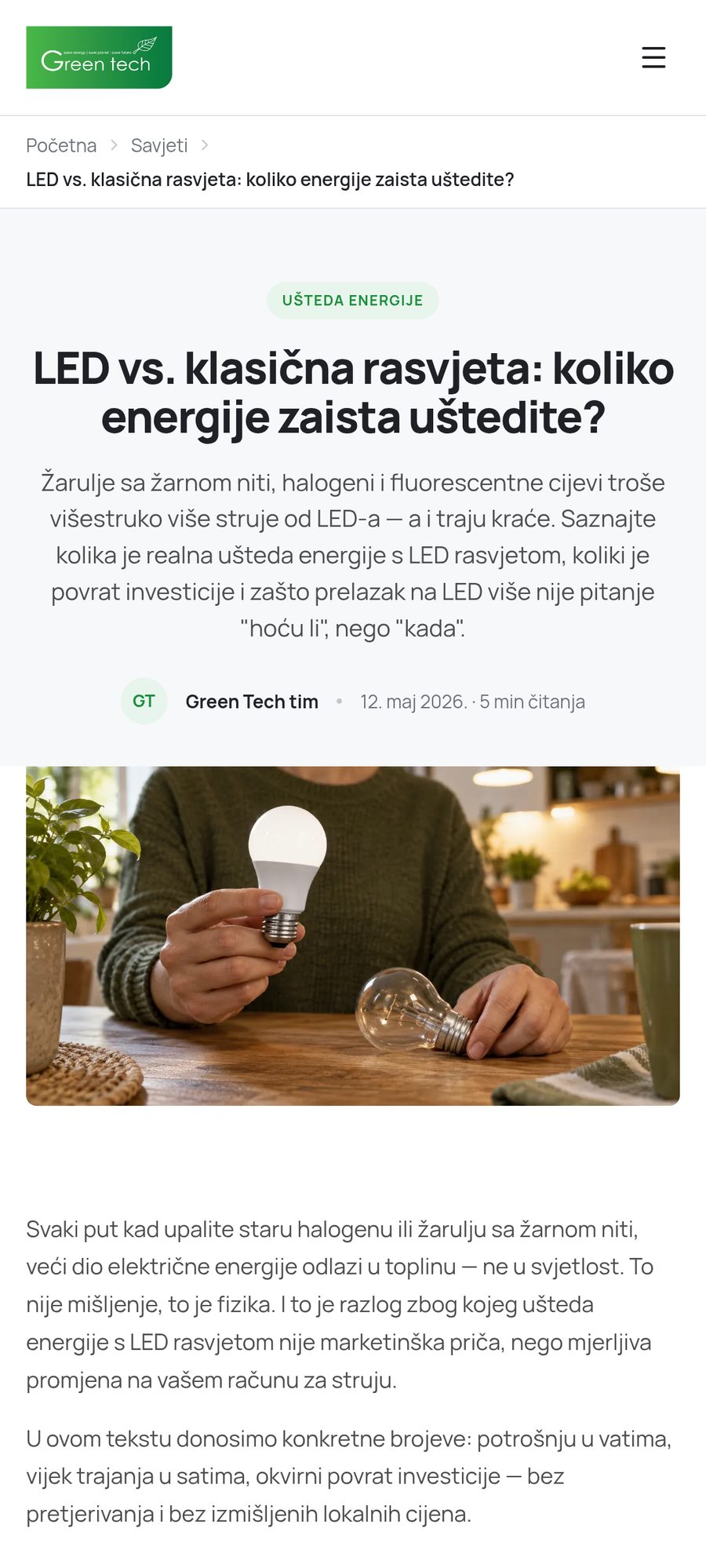
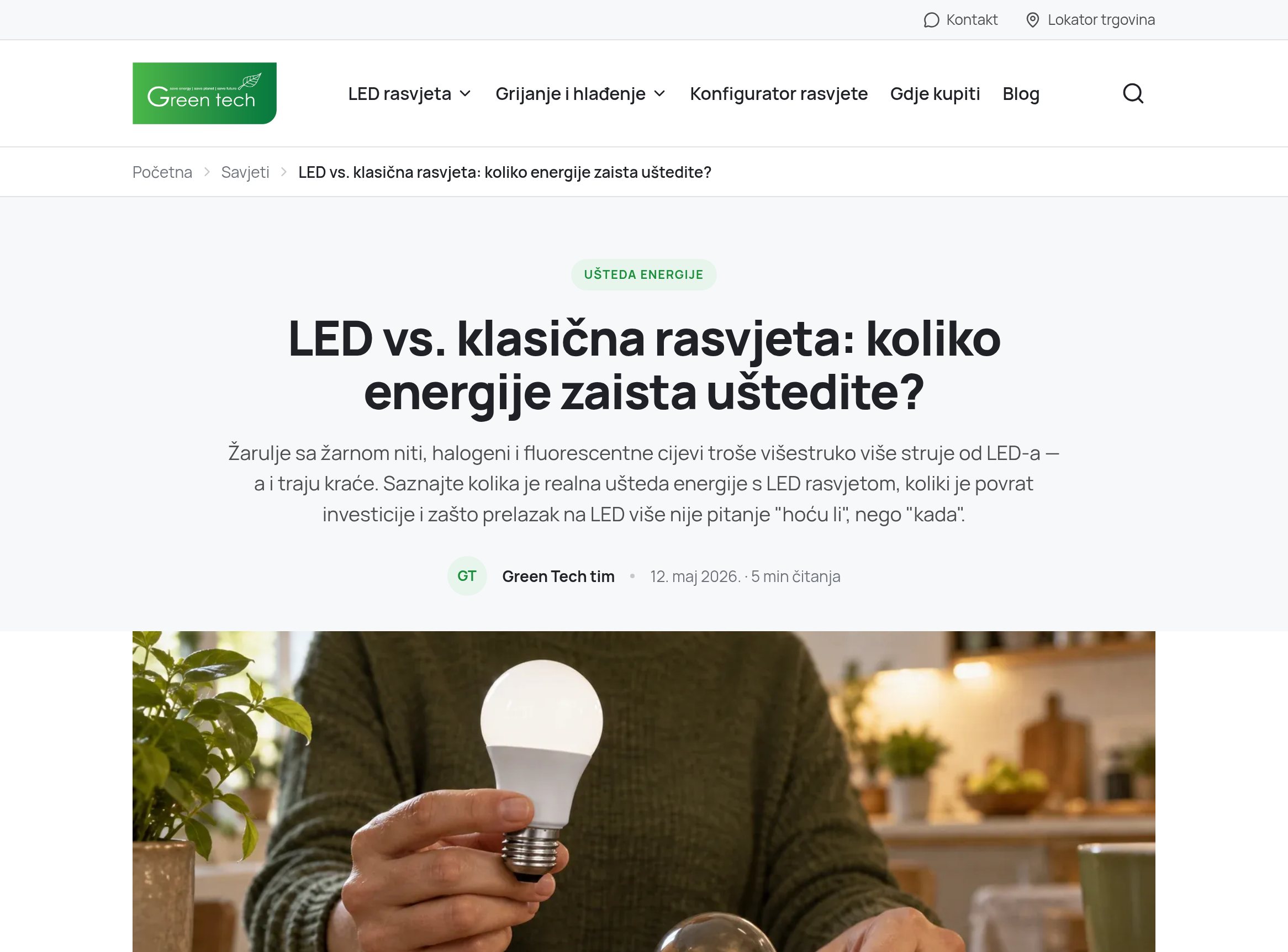
Green Tech guide on LED versus classic lighting
Inverter air conditioner category on mobile
02 / Data

Product data you can verify

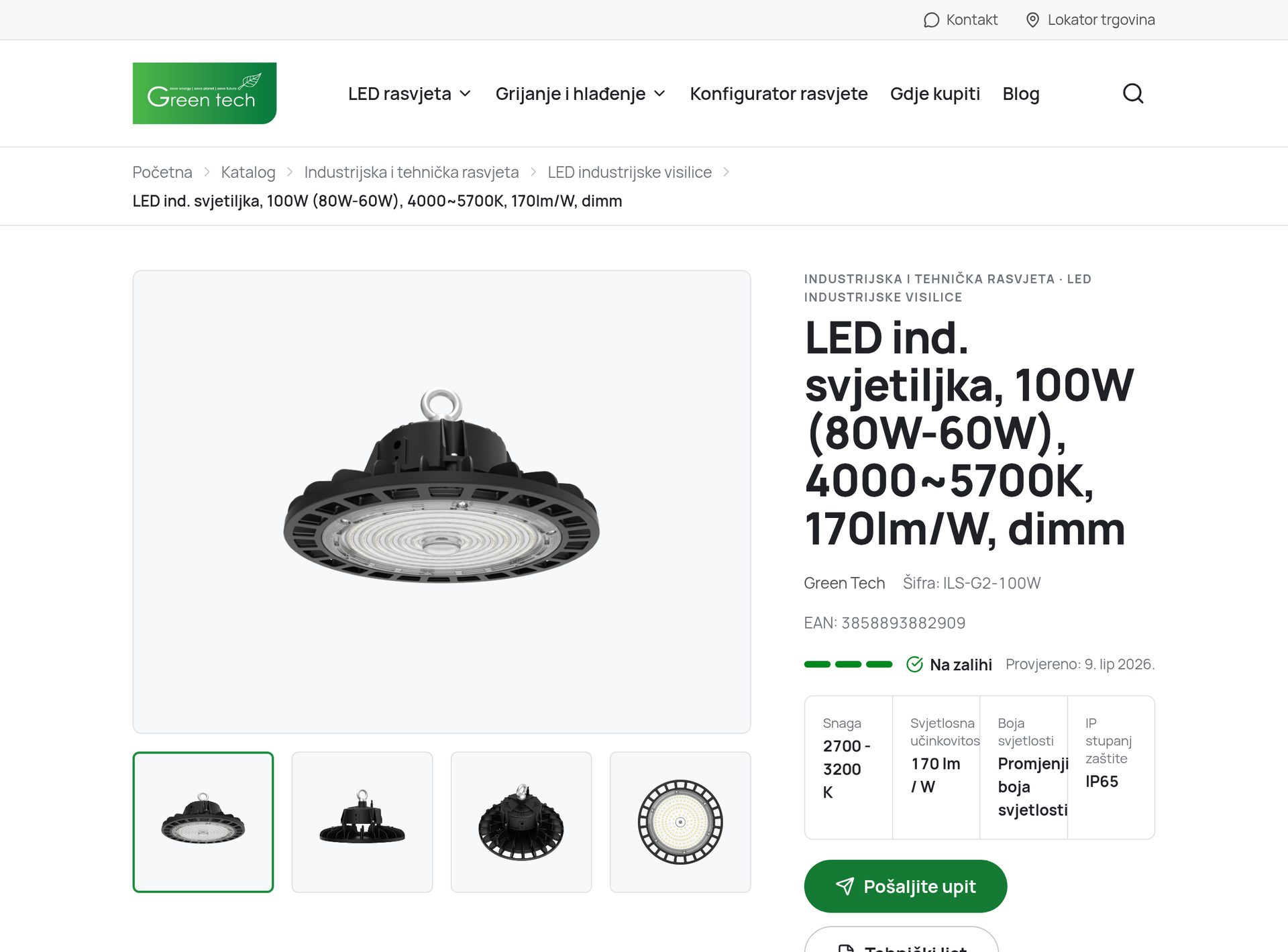
For an LED fixture, the numbers are the product. A contractor chooses a high-bay light for a warehouse by its lumens per watt, its beam angle, its IP and IK ratings and its operating temperature. If one of those numbers is wrong, the light goes into the wrong building. Green Tech's data came from several places, and nobody could say which products had been checked and when.

We modelled every product in Payload as structured data, not as a block of text. Electrical, light and mechanical data, certificates, EAN, product code, datasheets and CE documents each have their own field. The front end builds the spec table, the filters and the comparisons from those fields.

Checks before publishing

AI Studio verifies product data the same way an engineer would. It looks for empty fields, values outside a sane range, units in the wrong field and conflicts between the spec table, the description and the datasheet. It flags each problem for the editor with the reason, instead of correcting numbers on its own.

The decision: show the date

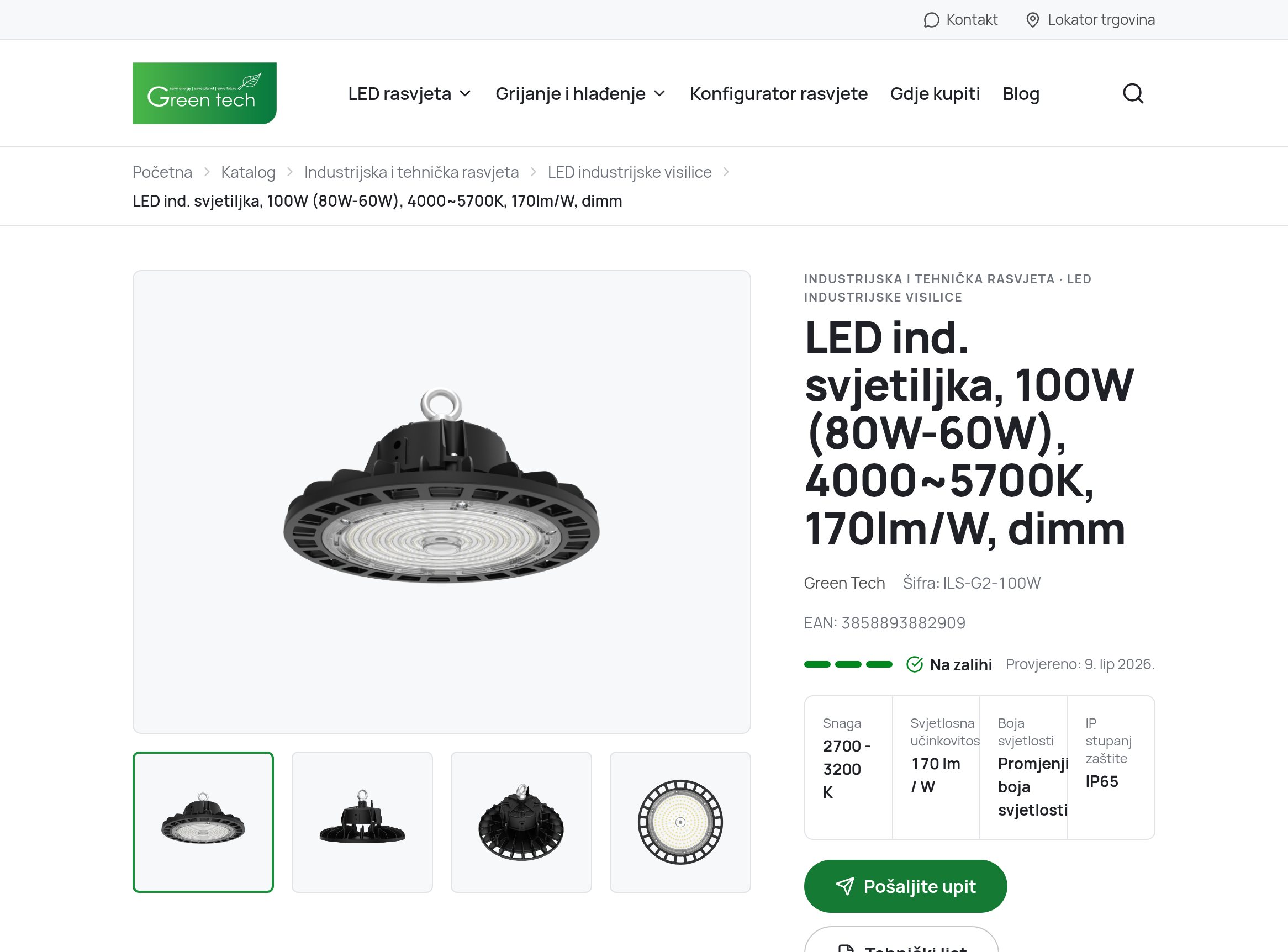
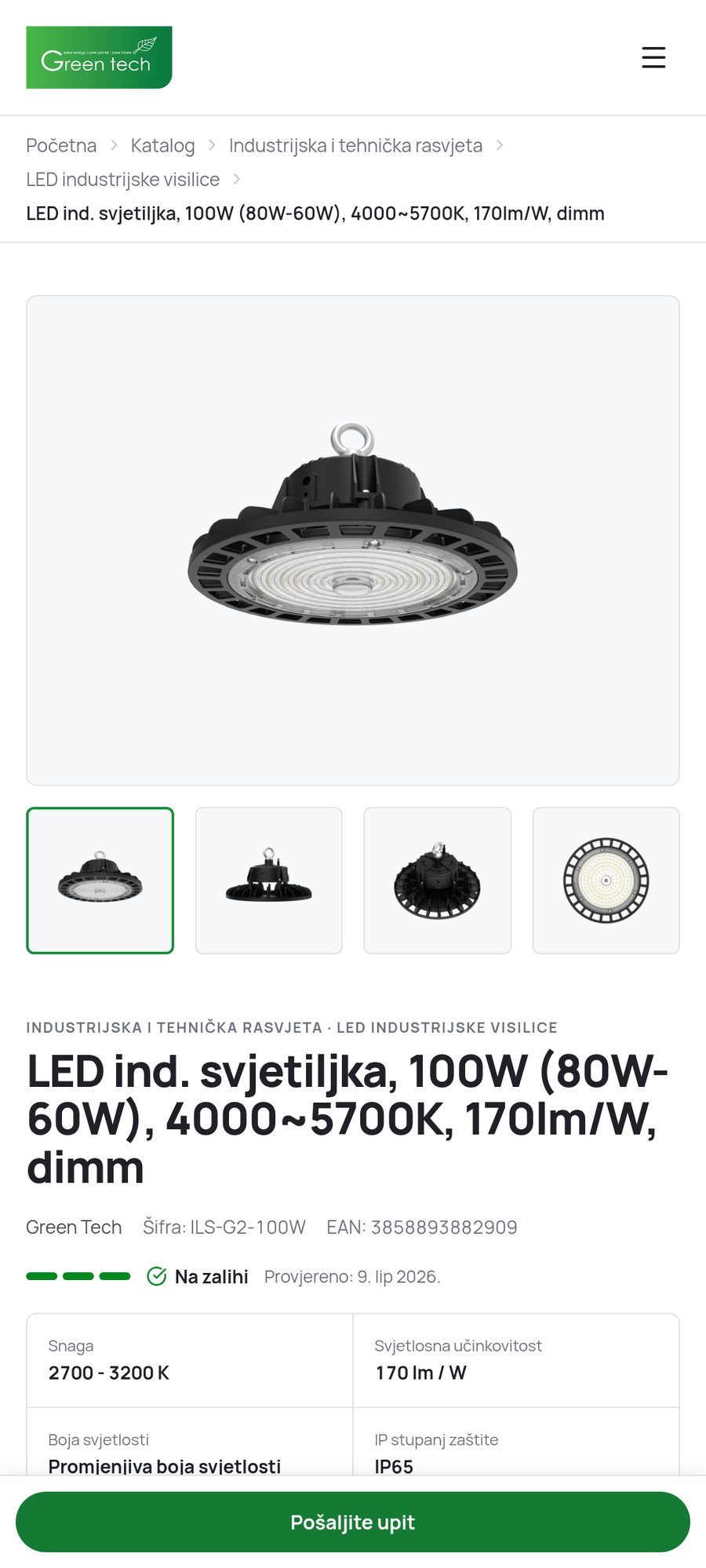
Each product page shows when its data was last verified, next to the stock state. It is a small line, but it changes how buyers read the page: the numbers have an owner and a date. Inside the CMS, the same data tells the team which products still wait for a check.

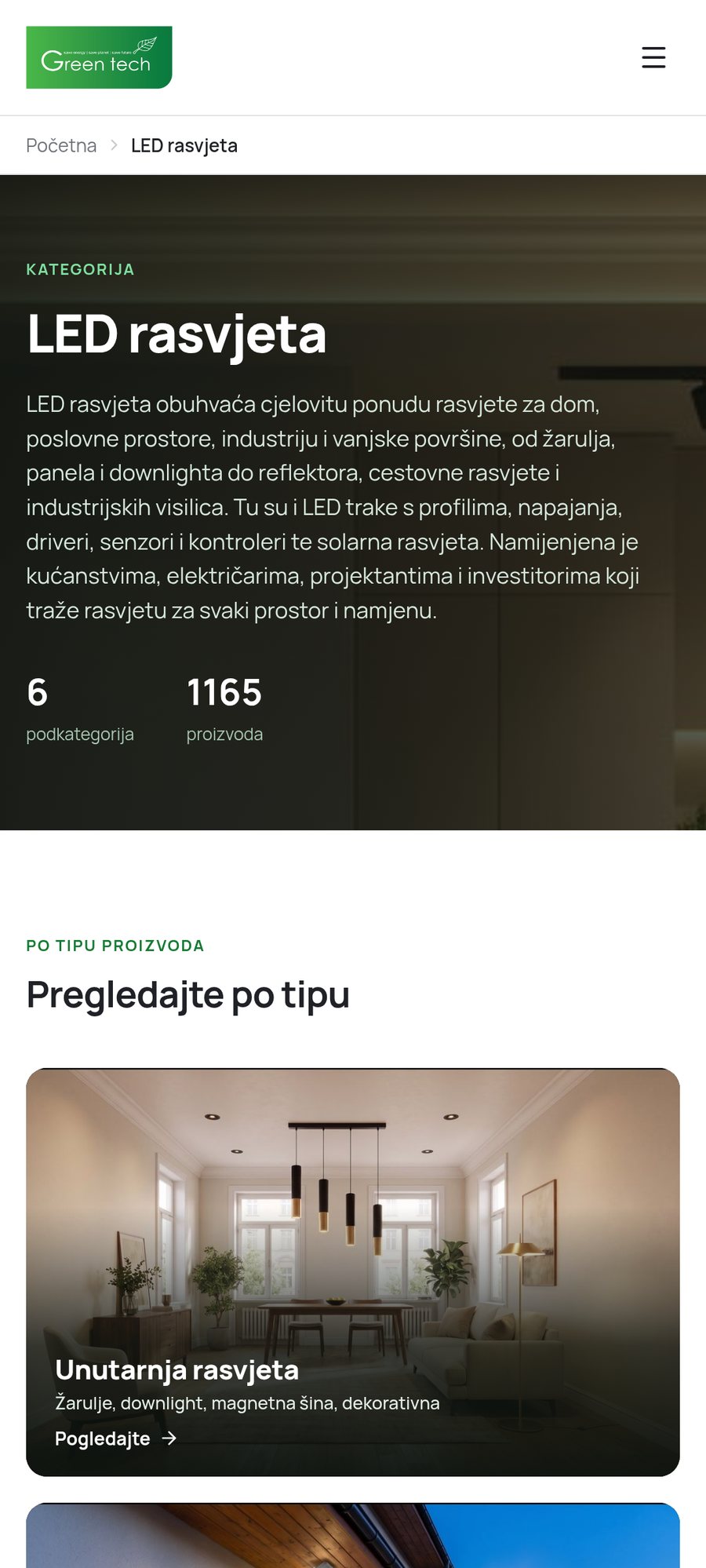
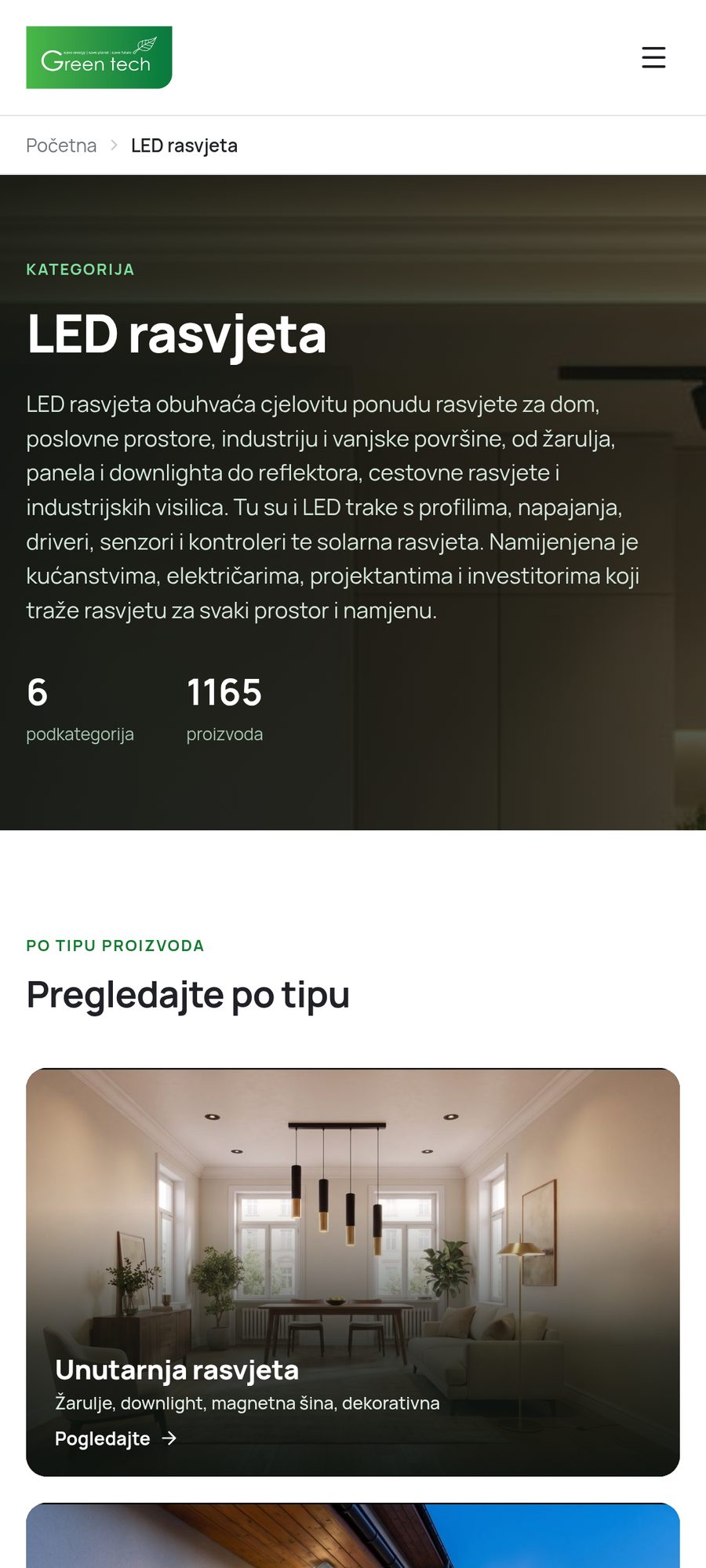
Category pages read the same fields. LED lighting alone holds 1,165 products in six subcategories, with filters for material, light colour, power and protection that come directly from the data.

  • Structured specs, certificates and documents for 1,200 products
  • AI checks for gaps, ranges and conflicts
  • A verified date on every product page
Product page with specs, EAN, stock state and verified date
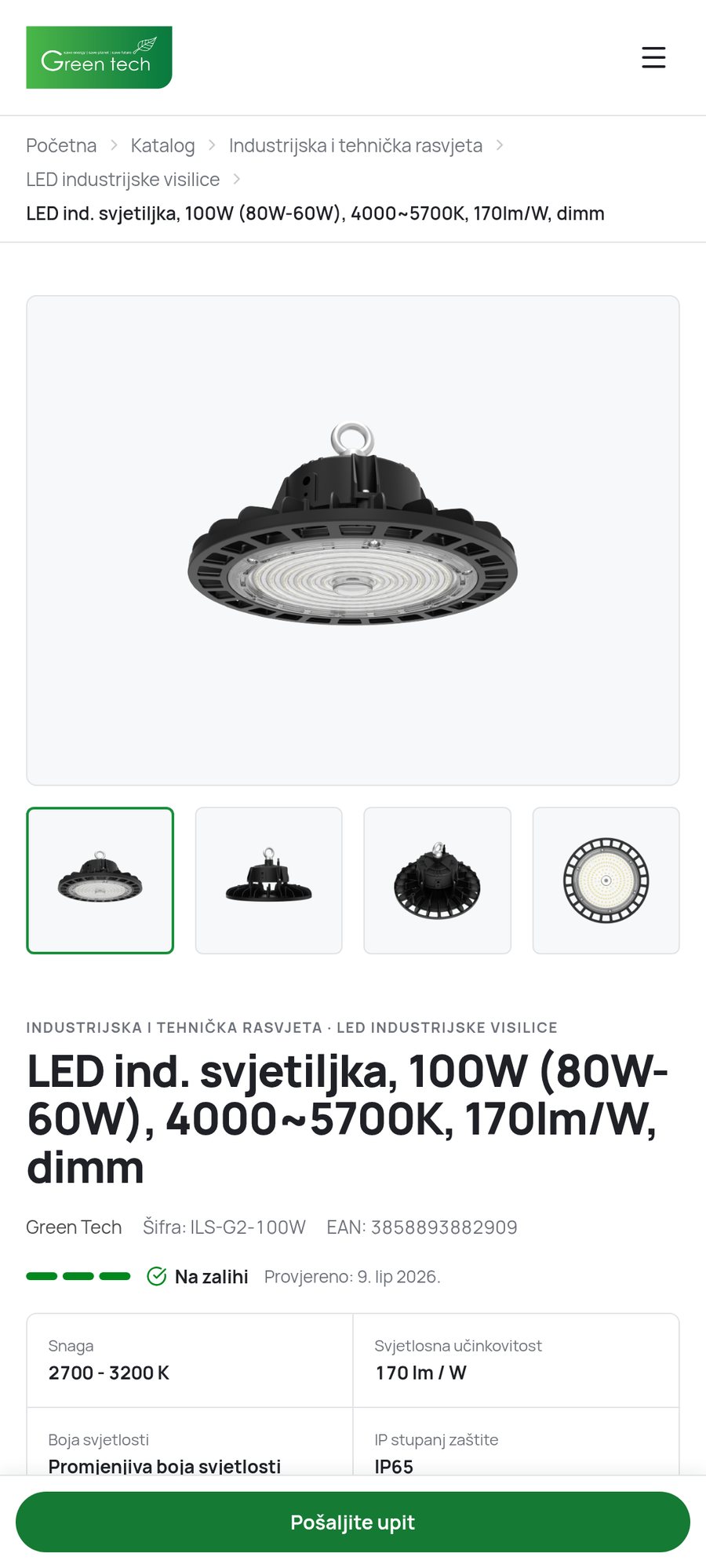
Product page with stock state and spec cards on mobile
03 / ERP

Partners and stock from Pantheon, every day

Green Tech does not sell online. A buyer finds a product on the site and buys it from a partner nearby: a distributor, a retailer, an installer or a service centre. That only works if the site knows who the partners are and what is in stock. Both lived in Green Tech's Pantheon ERP, and the website could see neither.

We built a custom integration with Pantheon that runs every day. It reads the partner list with names, addresses, towns, countries and partner types, and it reads stock for every product in the catalogue.

A store locator that stays current

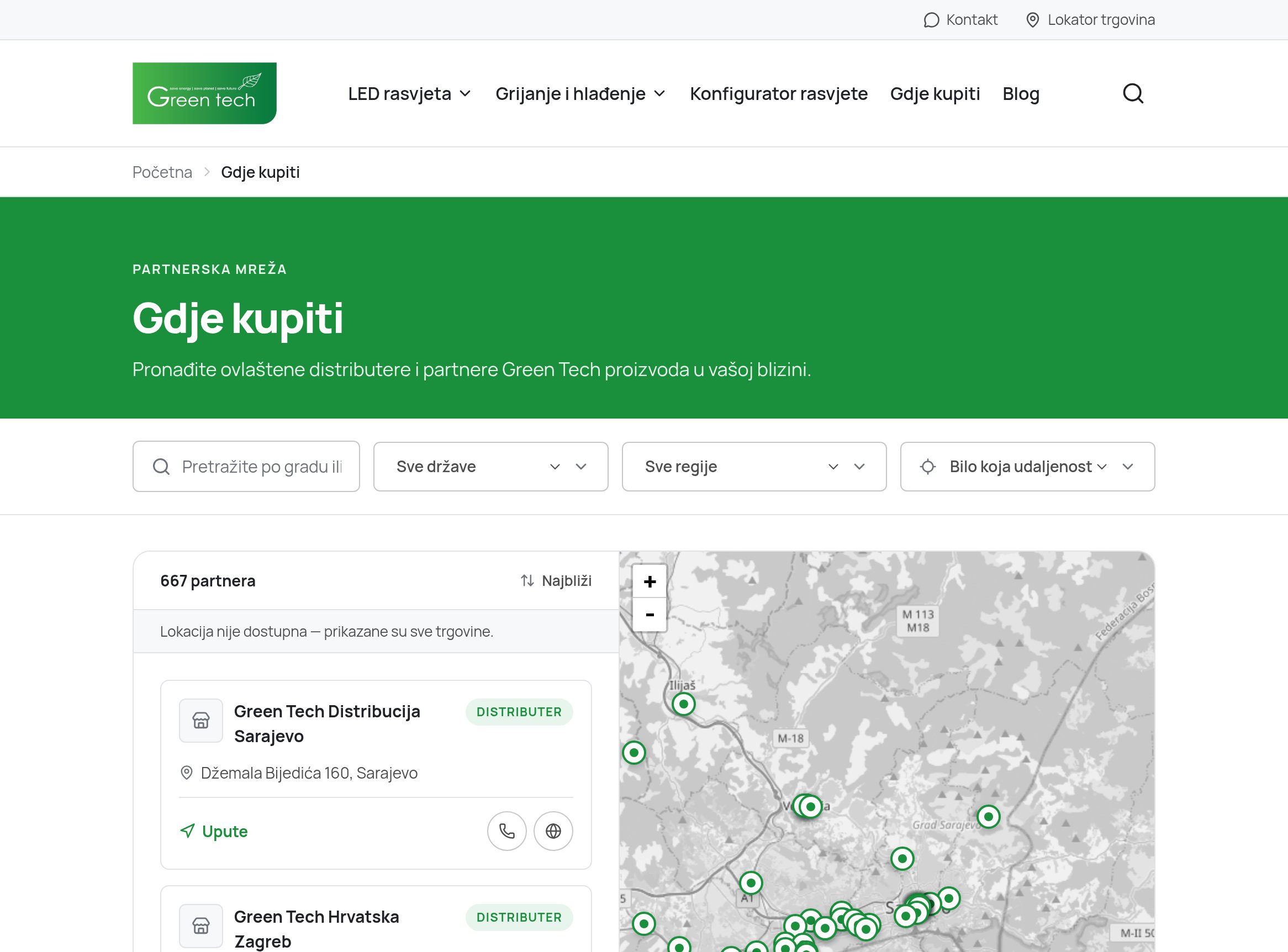
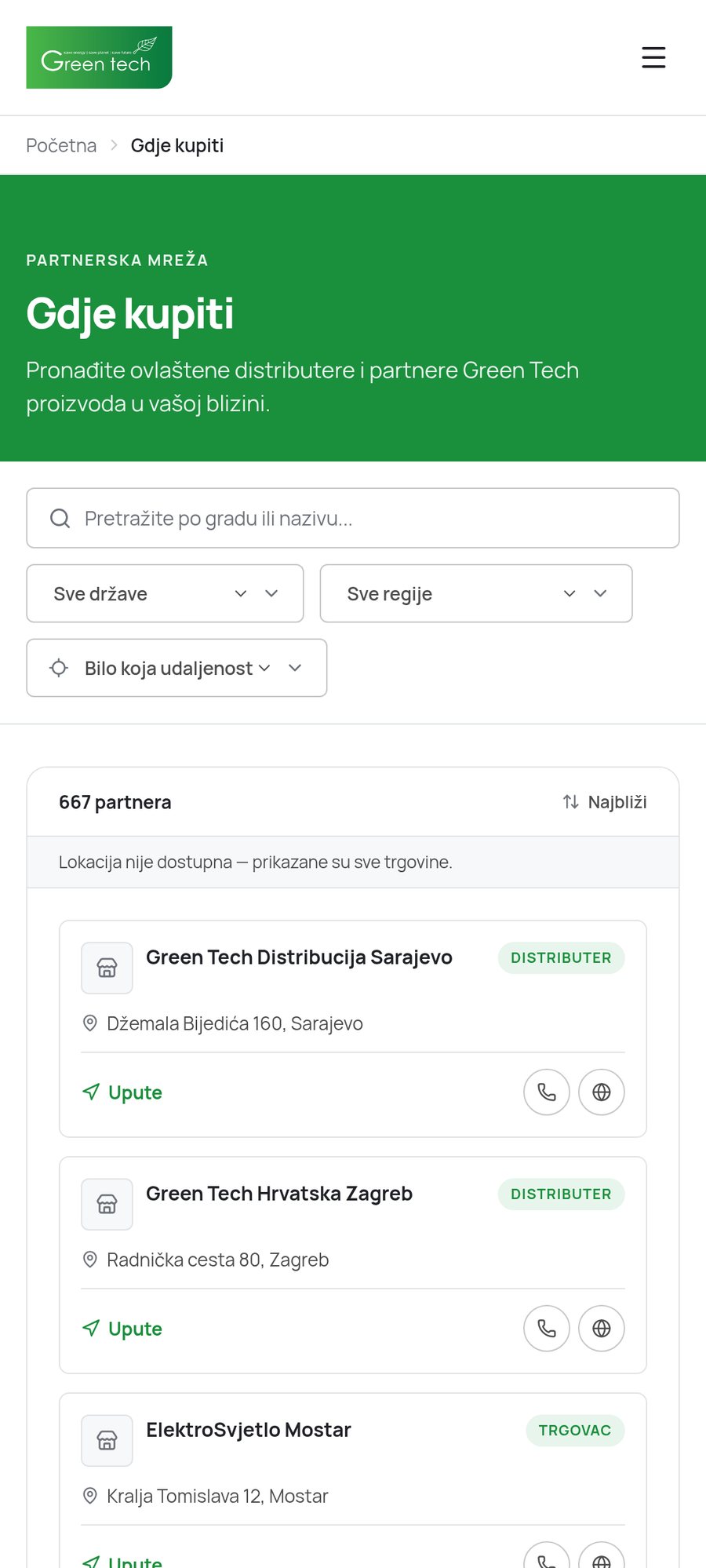
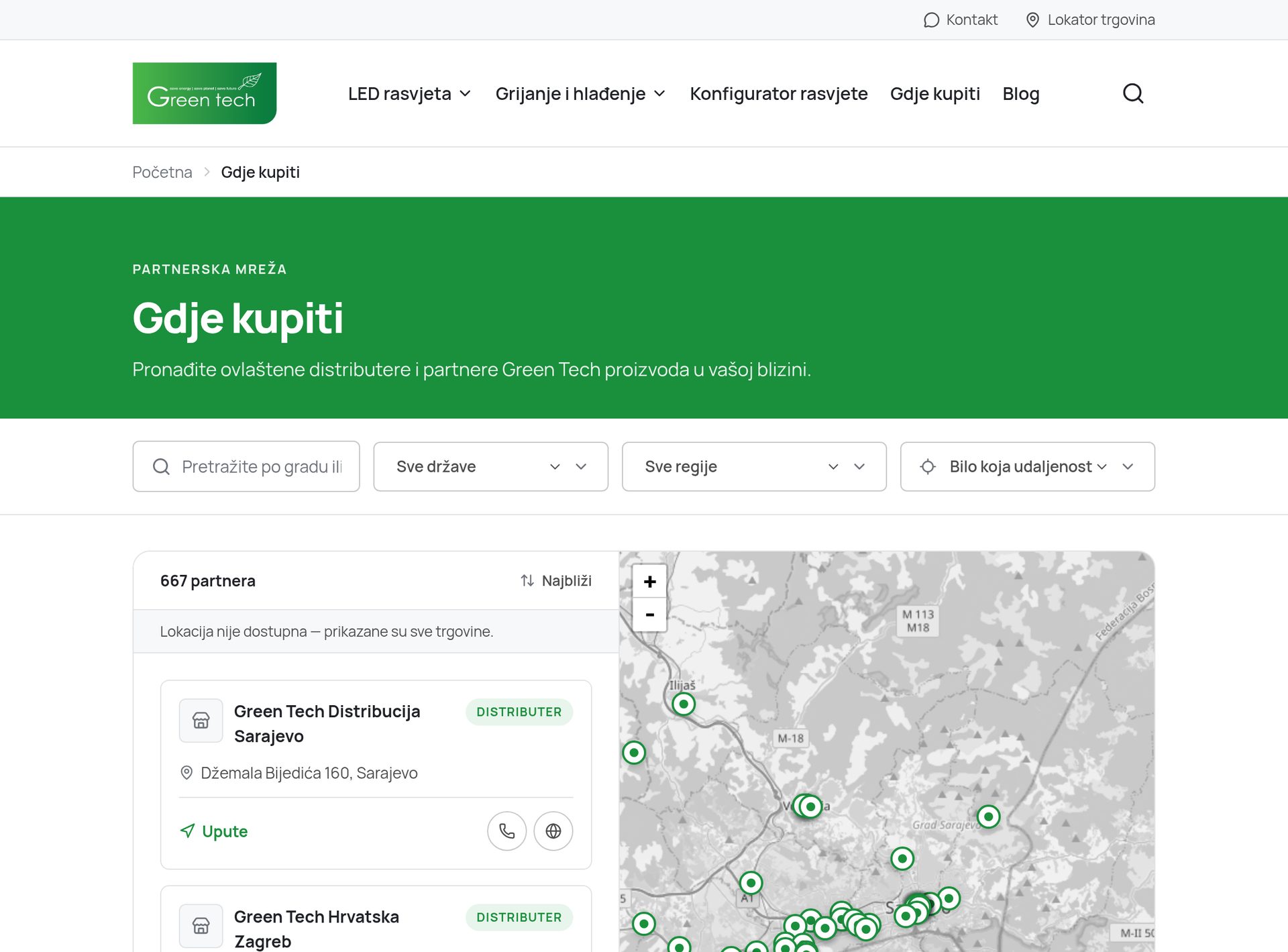
The Gdje kupiti page shows the partner network on a map, with filters for country, region and distance and a sort by the nearest partner. Each entry shows the partner type, the address, a phone button and directions. When Green Tech signs a new partner in Pantheon, the site lists it the next day, and no one edits the map by hand.

Product pages use the same data. Below the specs, a buyer sees which partners near them sell Green Tech products, with phone numbers and directions.

Stock where the buyer decides

Every product shows its stock state from Pantheon. A contractor planning a project sees at once if the fixture is available, and the enquiry form starts from that fact.

The decision: the ERP owns the facts

We did not copy partners and stock into the CMS for editors to maintain. Pantheon owns them, and the site reads them. The CMS owns what the ERP cannot hold: descriptions, translations, images and documents. Each fact has one home.

  • Daily partner and stock sync from Pantheon ERP
  • Store locator with country, region and distance filters
  • Partners near the buyer on every product page
Store locator with 667 partners on a map
Store locator with partner filters on mobile
04 / Sync

One catalogue across every site

Green Tech's products appear in more places than its own website. Trade partners order through the Green Tech B2B website, and hundreds of partners list Green Tech products on their own sites. Each of those places can drift from the truth, and nobody had a full picture of where the products were.

B2B product sync

We connected the new platform to the Green Tech B2B website, so products stay in step across both. The team works on a product once. Partners who order on the B2B site and buyers who browse the public catalogue read the same product data.

Firecrawl across partner sites

To see the wider picture, we built a crawling pipeline on Firecrawl. It visits partner websites, reads their pages and collects the links that point to Green Tech products. The first batch crawled 12,000 partner pages. Doing that by hand would take a person months of clicking through other people's shops.

The crawler runs as a pipeline, not a one-off script. Green Tech can run it again when partners change their sites or new partners join, and the results land in the same system as the rest of the catalogue.

The decision: automate the boring, review the important

Syncs and crawls run without people. What they find goes to people: the team sees the results in the CMS and decides what to act on. The machines collect the data, and Green Tech decides what it means for its partners.

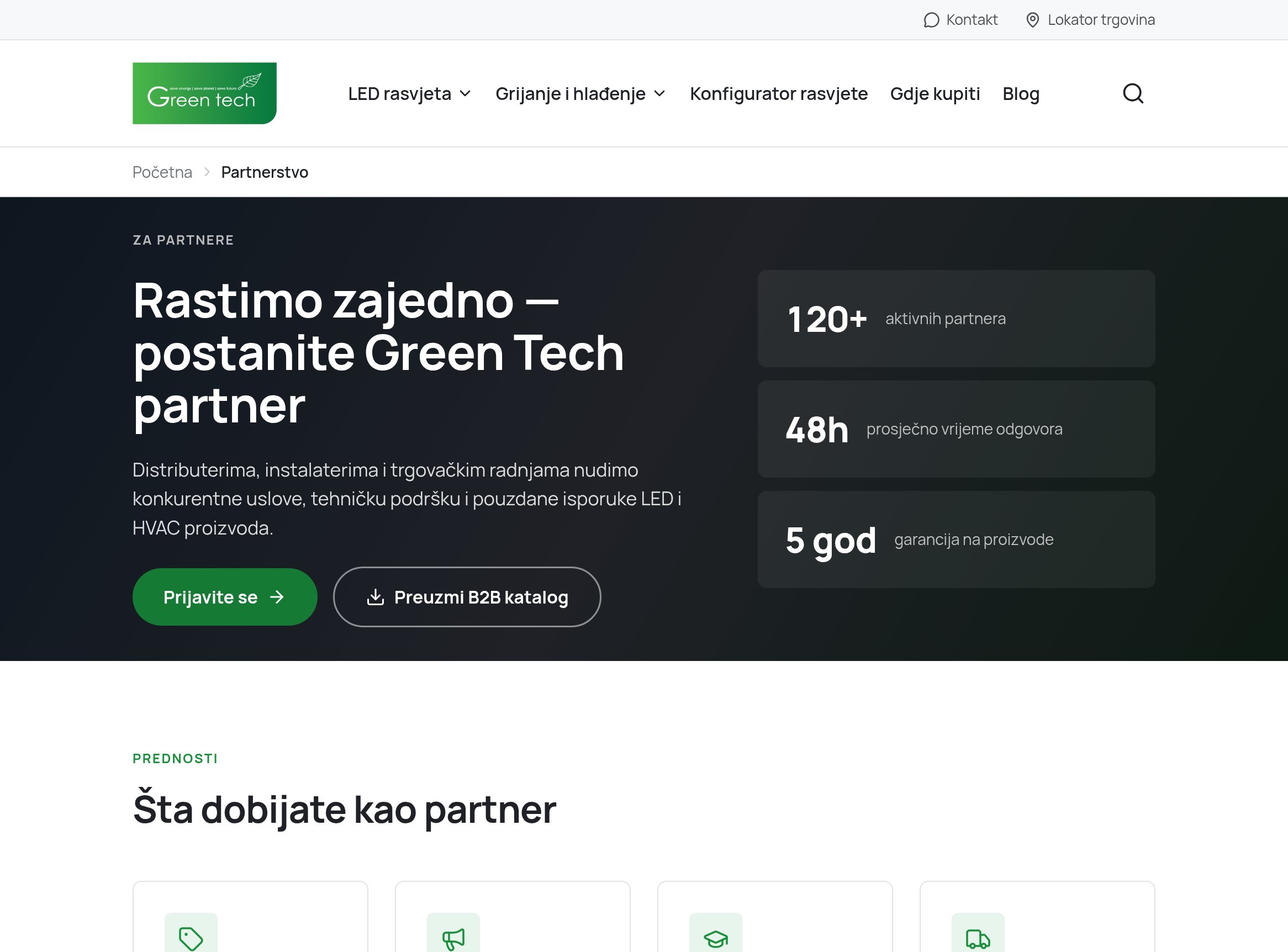
The partnership page closes the loop. New distributors, installers and retailers apply on the site and download the B2B catalogue, and once Green Tech signs them in Pantheon, the locator lists them.

  • Product sync with the Green Tech B2B website
  • Firecrawl pipeline, 12,000 partner pages in the first batch
  • Partner applications and the B2B catalogue on the site
Green Tech partnership page with partner numbers
Partnership page on mobile
05 / Generative UI

From a project brief to a product list

Many Green Tech buyers do not buy one lamp. They light a warehouse, an office floor, a car park or a street. Before, a contractor had to call or write, describe the project, wait for an engineer and then compare products from the catalogue. The first answer took days.

We built the project solutions page around generative UI. The interface builds itself from the buyer's answers and from the catalogue, instead of showing the same page to everyone.

Seven questions, a first estimate at once

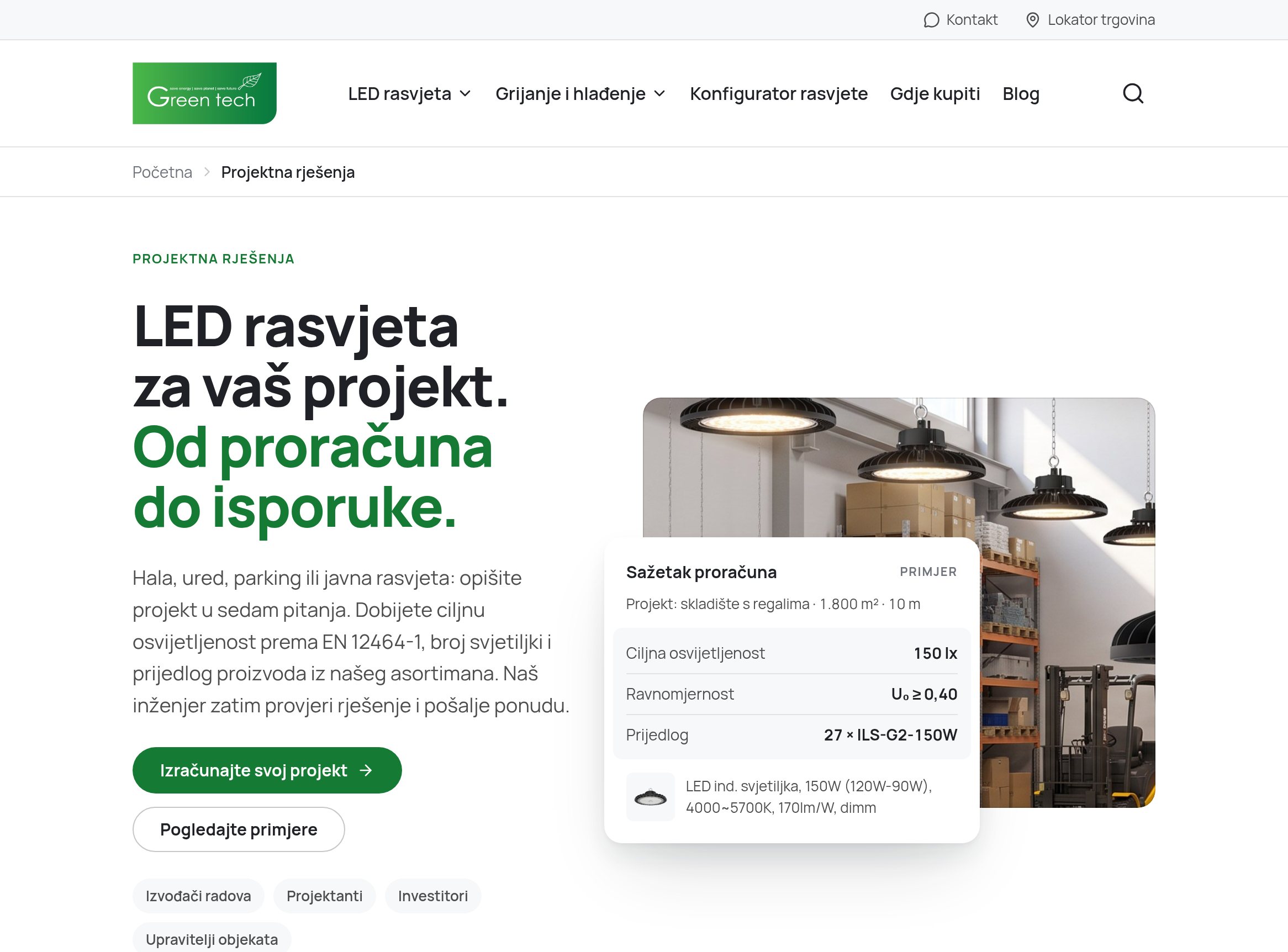
The project configurator asks seven questions: project type, area and ceiling height, new build or replacement, light colour, conditions such as moisture and dust, quantity and deadline. As the buyer answers, it shows the target illuminance per EN 12464-1 and the total luminous flux, with no registration. After a business e-mail, it adds the number of fixtures and a product proposal from the Green Tech range: for a 1,800 m² warehouse with a 10 m ceiling, 150 lx and 27 × ILS-G2-150W.

An AI advisor that knows the catalogue

Next to the result, an AI advisor answers follow-up questions from the catalogue and the standards: do I need IP65, which product do you suggest, how much will I save. It does not invent products, because it can only answer from Green Tech's data.

The decision: AI proposes, an engineer confirms

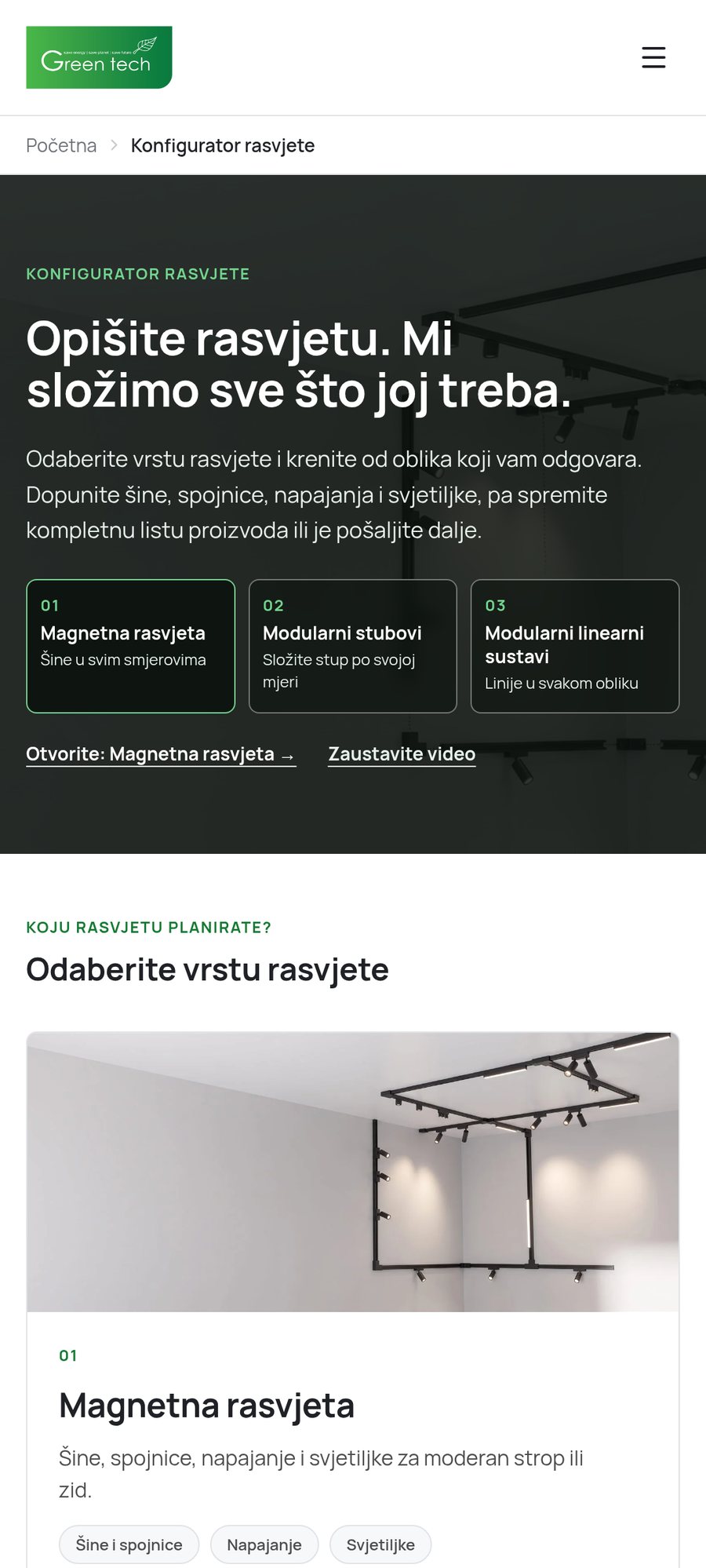
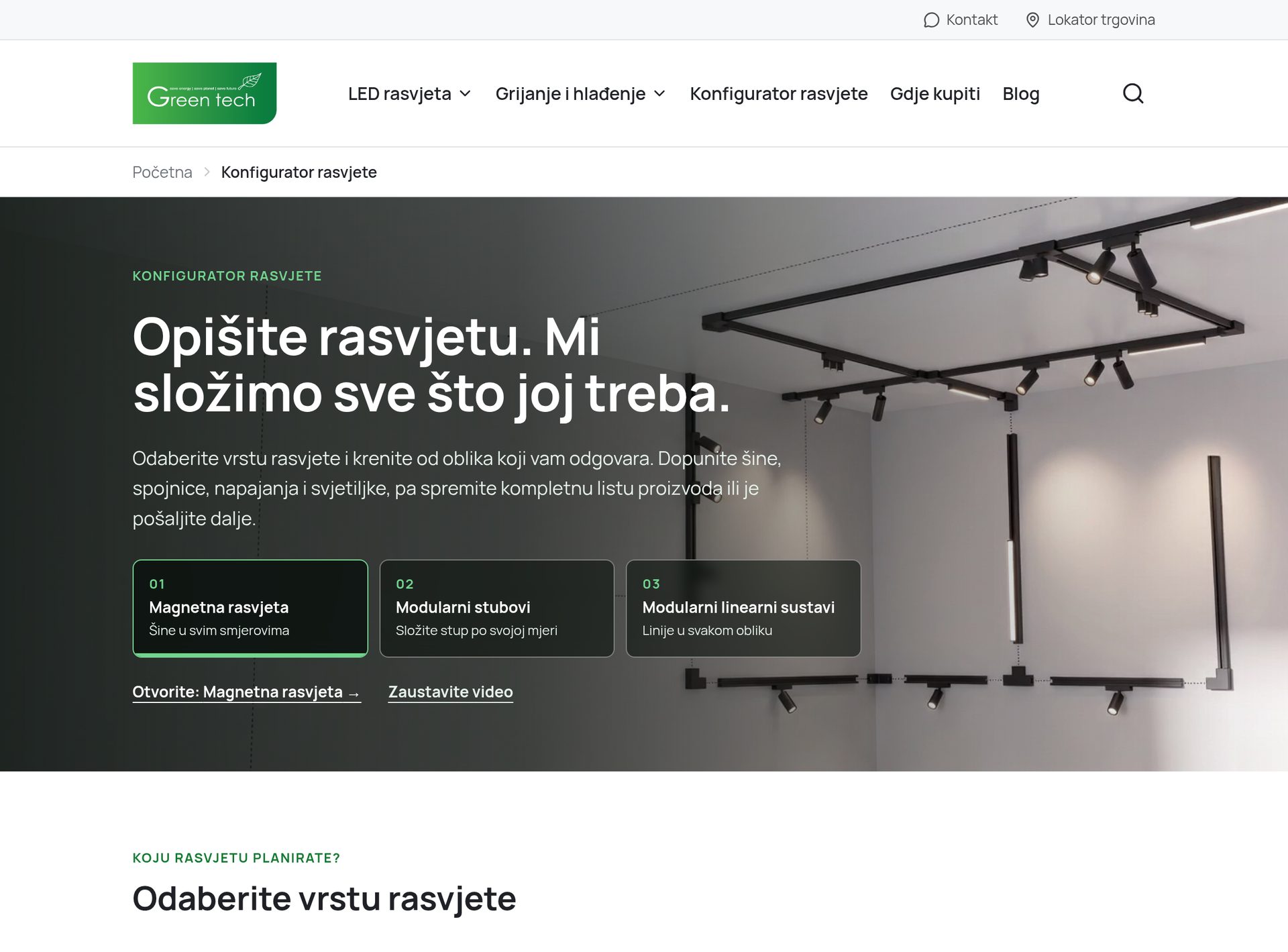
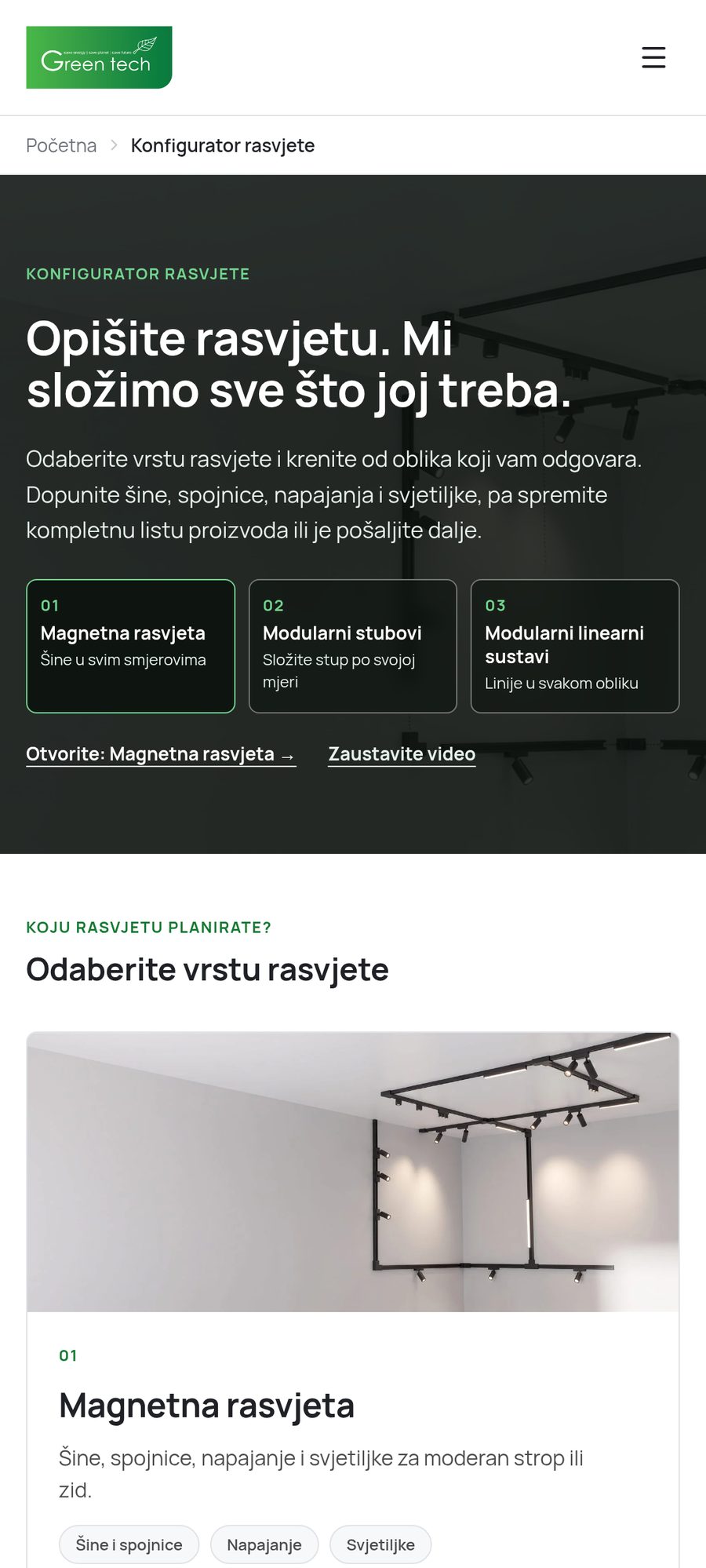
The estimate is a starting point, and the page says so. A Green Tech engineer checks every proposal and replies within 24 hours with an offer. The lighting configurator works the same way for magnetic track, modular poles and linear systems: the buyer builds the shape, and the page builds the parts list.

  • Generative UI on the landing pages
  • EN 12464-1 estimate and a product proposal in about 3 minutes
  • AI advisor grounded in the catalogue, checked by an engineer
Project solutions page with a sample lighting budget
Lighting configurator on mobile
06 / Build

Astro, Payload and AI the team can use

A platform with this many moving parts needs a simple core. We built Green Tech on two tools we trust: Astro for the public site and Payload CMS for the content, the data model and the integrations.

Astro renders the catalogue as fast, mostly static pages and adds interactive parts only where they are needed: the configurators, the store locator map, search and filters. Payload holds products, categories, pages, blog posts and documents in typed collections, and it hosts the integrations with Pantheon, the B2B website and Firecrawl as well as the AI Studio plugin.

Two languages from the start

The site runs in HR/BS and English, with a language switch on every page. Every field in Payload has both languages, and AI Studio translates and checks them, so an English buyer sees the same product data as a local one.

MCP editing

We gave Payload an MCP server, so the team can read and edit CMS content through AI assistants. An editor can ask an assistant to update a set of products or draft a page, and the change goes through the same fields, validation and permissions as a change in the admin.

The decision: enable people, not only software

Six months of AI work is wasted if the team keeps working the old way. Part of the project was AI enablement: training the Green Tech team on AI Studio and MCP, and writing the rules the AI follows for tone, terms and units in both languages. The team saved 5,000 hours because it uses the tools every day.

  • Astro front end, Payload CMS back end
  • HR/BS and English across the site and the CMS
  • MCP editing and AI enablement for the team
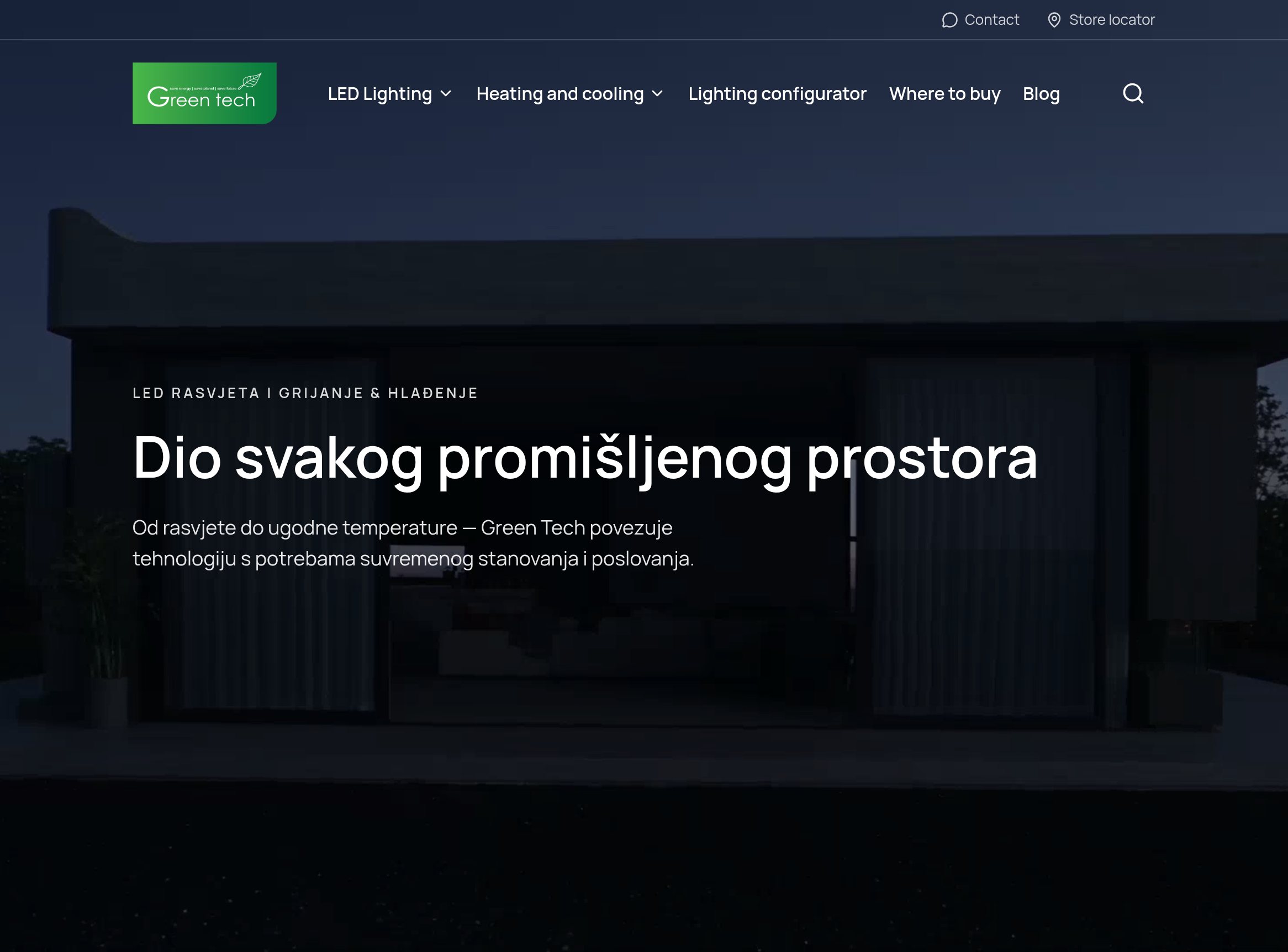
Green Tech homepage in English
LED lighting category on mobile
03 / 03The Results
Lighting configurator for magnetic track, modular poles and linear systems
Product page with specs, stock state and verified date on mobileProject solutions and the budget summary on mobile
Lighting configurator on mobileLED lighting category with 1,165 products on mobile
Partnership page with partner benefits on mobileEnergy-saving guide on the Green Tech blog on mobile
01 / 04
Team
  • Adnan
  • Alen
  • Vaha
  • Mirza
  • Adis
  • Azra
  • Sara
  • Fedja
6 months · 7 services
Store locator with 667 partners on a map
Outcome

A catalogue that writes, checks and syncs itself, with people in control.

Product page with EAN, stock state and verified date
Result 01

5,000 Hours Saved

AI Studio, the ERP sync and the crawler took over writing, translating, checking and updating work that the team did by hand, and saved Green Tech 5,000 hours.

Result 02

1,200 Products, Two Languages

1,200 LED and HVAC products have structured specs and copy in HR/BS and English, improved and checked in AI Studio before an editor publishes them.

Result 03

Stock and Partners, Daily

Partners and stock come from Pantheon every day, so the store locator and the stock state on each product show what the ERP says, not what someone typed last month.

Result 04

12,000 Partner Pages Crawled

The first Firecrawl batch read 12,000 partner pages and collected the product links on them, work that no one on the team could do by hand.

Result 05

One Catalogue, Two Sites

The public site and the B2B website share the same products, so trade partners and end buyers read the same data.

Result 06

From Project to Proposal

Contractors and planners describe a hall, an office or a car park in seven questions and get a target illuminance, a fixture count and a product proposal, which a Green Tech engineer then checks.

Next Project

Texas Corn Producers

Association View case study
Texas Corn Producers — project preview

Does your catalogue still run on spreadsheets?

If your product data lives in an ERP, in datasheets and in people's heads, let's build a platform that keeps it true and lets AI do the heavy work.

Thank you. Your message has been received.
Your message could not be sent. Please try again.